
Should You Get a Whole Body MRI Scan in Korea?
“A whole body MRI shouldn’t be a passive scan followed by weeks of waiting. It should be an active clinical process — where radiologists guide the exam in real time and patients receive meaningful insight the same day.” Donkyo Seo, CEO of Himedi
Considering Prenuvo?
Whole body MRI is becoming one of the most talked-about preventive health screenings. Companies like Prenuvo helped introduce the idea to a broader audience: using advanced imaging to detect potential health issues early. Once people understand the concept, however, the question changes.
It’s no longer simply:
“Should I get a whole body MRI?”
Instead, the more important question becomes:
“How is the scan actually performed in a real clinical setting?”
Key questions patients should consider include:
-
Who interprets the images?
-
Is a radiologist involved during the exam?
-
What happens if something concerning appears?
This is where Korea’s medical system offers a different model.
Korea
Korea is widely recognized as one of the most advanced environments in the world for MRI imaging. According to the Korean Society of Magnetic Resonance in Medicine:
-
Korea ranks 3rd in the OECD for MRI units per million people
-
Korea ranks 1st globally for MRI scans performed per million people
This high density of MRI systems creates something powerful: experience.
Radiologists in Korea interpret a very large number of MRI studies every year. This volume helps refine diagnostic judgment, improve accuracy, and accelerate the adoption of new technologies such as:
-
AI-assisted image analysis
-
ultra-fast MRI protocols
-
advanced 3.0 Tesla imaging systems
As a result, MRI in Korea is not just a diagnostic test — it is deeply integrated into routine clinical care.
Comparison
Prenuvo: Enhanced Screening with Whole Body Scan vs. Medione (via Himedi): Whole Body MRI + Checkup
| Prenuvo | Medione (via Himedi) | |
|---|---|---|
| MRI Strength | 1.5 Tesla | 3.0 Tesla (higher resolution imaging) |
| Clinical Model | Centralized off-site radiology reading | On-site radiologist-led interpretation |
| Radiologist Intervention | Not available | Radiologist can intervene during scanning |
| Patient Feedback | No same-day consultation | Same-day preliminary clinical discussion |
| Full Result Turnaround | 3-4 weeks | 2 weeks |
| Price | $3,999 | $2,000 |
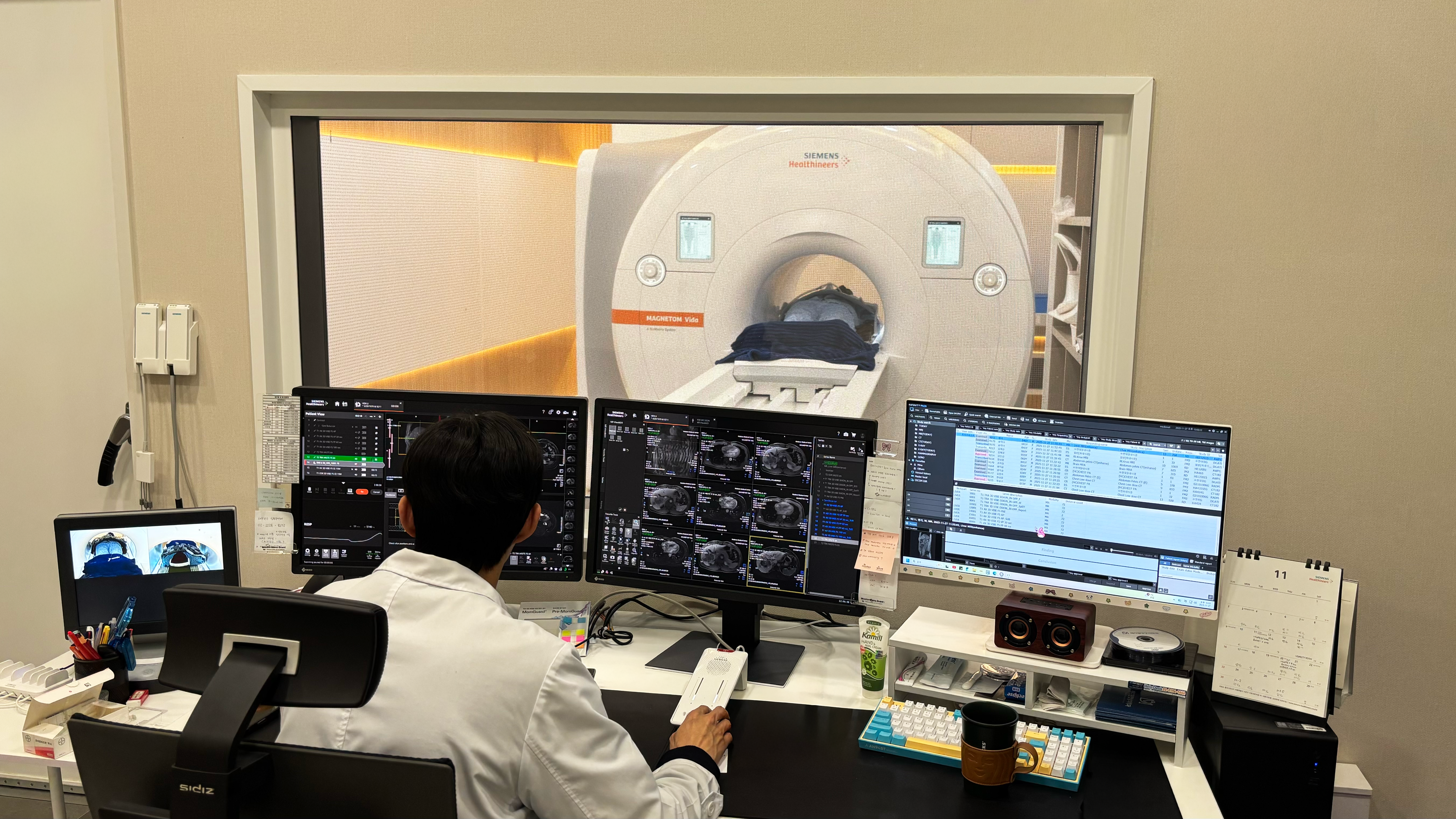
The biggest difference is how the scan is interpreted. In many screening models, the MRI is performed first and then interpreted remotely later. In Korea’s clinical workflow, radiologists are often physically present in the clinic, allowing them to:
-
monitor the scan in real time
-
adjust imaging protocols when needed
-
order additional sequences if a finding requires clarification
-
discuss preliminary insights with the patient the same day
This approach transforms the MRI from a passive scan into an active diagnostic process.

Package Details: Whole Body MRI + Checkup
| Exam | Detailed Items |
|---|---|
| MRI |
1. Brain MRI
Silent cerebral infarction / chronic ischemic changes
Dementia-related changes (Alzheimer’s: hippocampal atrophy; vascular dementia)
Brain tumors (meningioma, glioma, metastasis)
Demyelinating diseases (e.g., multiple sclerosis)
Congenital structural anomalies (arachnoid cyst, Chiari I malformation)
2. Brain MRA
Intracranial aneurysm
Cerebral arterial stenosis or occlusion
Moyamoya disease
Vascular malformations (AVM, DVA)
Vascular variants (infundibulum, fenestration)
3. Cervical Spine MRI
Cervical disc herniation (HIVD)
Cervical spinal canal stenosis
Cervical alignment abnormalities (loss of lordosis/kyphosis)
Spinal cord compression lesions
Degenerative cervical spondylosis
4. Mediastinum MRI
Thymic lesions (thymoma, thymic hyperplasia)
Mediastinal lymphadenopathy
5. Abdomen (Liver–Pancreas–Kidney)
Fatty liver / chronic liver disease
Hepatic masses (hemangioma, FNH, adenoma, HCC)
Pancreatic tumors or ductal dilatation
Renal cysts and renal cell carcinoma
Biliary disease (gallstones, bile duct dilatation)
6. Lumbar Spine MRI
Lumbar disc herniatio
Lumbar spinal canal stenosis
Degenerative lumbar spondylosis
Nerve root compression
Spinal tumors or metastatic disease
7-1. [Female] Pelvis
Uterine fibroids / adenomyosis
Ovarian cysts or ovarian tumors
Pelvic inflammatory disease
Pelvic lymphadenopathy
Pelvic vascular congestion
7-2. [Male] Prostate (Prostate MRI)
Benign prostatic hyperplasia (BPH)
Prostate cancer (clinically significant lesions)
Prostatitis / inflammatory changes
Prostate nodules (transition vs peripheral zone)
|
| X-Ray | Chest X-Ray |
| Blood tests | Liver, hepatitis, kidney, gout, CBC, rheumatoid, inflammatory, pancreatic, diabetes, anemia, thyroid, electrolyte, cardiac, lipids |
| Tumor markers | AFP(liver), CEA(colon), CA 19-9 (pancreas), PSA (male), CA125(female) |
| Specimen | Glucose, bilirubin, ketone, SG, pH, protein, urobilinogen, nitrite, blood, RBC, WBC |
| Vitals & Function | Height, weight, body composition, blood pressure, audiometry, EKG |
| Vision Test | Visual Acuity, Fundus Exam |
Global Top-Tier 3.0T MRI Technology
Medione is equipped with the Siemens MAGNETOM VIDA 3.0T MRI, a research-grade system used by Korea’s top university hospitals.

- 60/200 gradient system used in advanced research
- AI-powered ultra-fast protocols (some sequences in ~3 minutes)
- High-definition imaging with reduced noise
A Different Approach to Preventive Imaging
In many places, whole body MRI is a screening product. In Korea, it is a clinical process. Radiologists guide the exam, helping ensure that the imaging answers real medical questions. The result is simple:
-
faster insight
-
clearer interpretation
-
greater peace of mind
This article was co-authored and medically reviewed by Dr. Won-Jeong Park (Radiologist) and Donkyo Seo, CEO of Himedi.
Interested in booking Medione?
Contact Himedi to start planning your Whole Body MRI in Korea.

Written by Himedi Inc.