

Longevity and Health: Korea vs. USA
How long we live matters. But how many of those years we live in good health may matter more. According to the World Health Organization's most recent Global Health Estimates (2021 data), healthy life expectancy in the U.S. is 63.9 years — meaning the average American spends roughly 15 of their years managing chronic illness or disability. In Korea, that number is 72.5 years. The 8.6-year gap is one of the widest in the developed world.
The U.S. spends $14,885 per person on healthcare each year — more than any nation on Earth, and roughly three times what Korea spends per person ($4,797). And yet Americans are spending a growing share of those years sick. Korea, on one-third the per-capita spending, leads the OECD in both overall and healthy life expectancy.
Life Expectancy vs. Healthy Life Expectancy
- Life Expectancy: how many years a person is expected to live, on average.
- Healthy Life Expectancy (HALE): how many of those years are lived free of major illness or disability.
Korea leads in both:
| Korea | United States | |
|---|---|---|
| Life expectancy at birth | 83.5 years | 79.0 years |
| Healthy life expectancy | 72.5 years | 63.9 years |
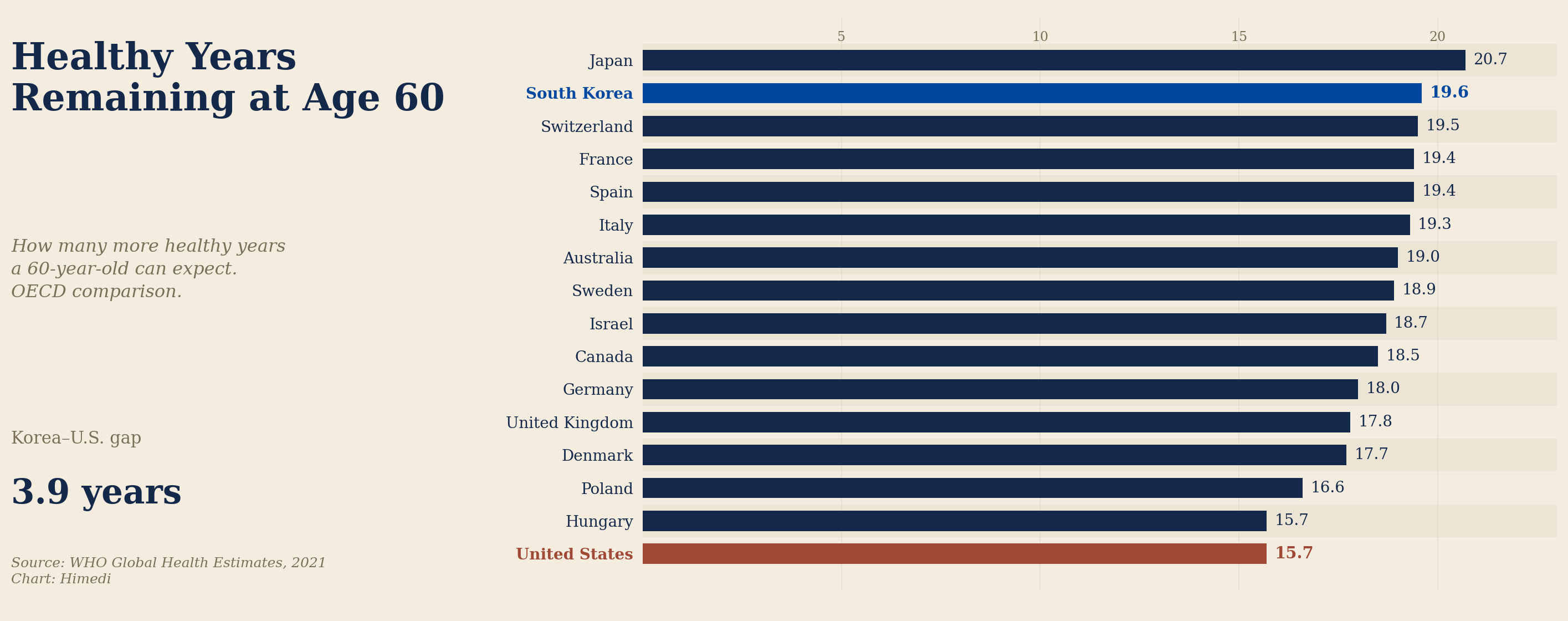
| Healthy years remaining at age 60 | 19.6 years | 15.7 years |
| Per capita health spending | $4,797 | $14,885 |
Life expectancy: Statistics Korea 2023 / CDC 2024. Healthy life expectancy and healthy years at age 60: WHO Global Health Estimates, 2021 baseline (the most recent comprehensive international comparison). Per capita health spending: OECD Health at a Glance 2025 (USD PPP, 2023 figures).
That last row matters most for anyone already in their 40s, 50s, or 60s. Reaching age 60 in Korea, on average, comes with nearly four more healthy years than reaching the same age in the U.S.

Korea and Japan both run efficient healthcare systems, but Korea is well ahead on services built for U.S. visitors — English coordination & concierge support. Strong government policy since 2009 met a private sector accelerated by Korea's demographic cliff.
Why Korea's Health Checkup System Excels
Korea's advantage isn't an accident — it's built on decades of investment in preventive care.
- National support. Backed by the National Health Insurance Service and Korea's Basic Health Checkup Act, preventive screening is treated as a basic right, not a luxury.
- Corporate partnerships. Companies partner with checkup centers to provide comprehensive packages as standard employee benefits, which keeps the system pushing to innovate.
- Global patient growth. In 2025, Korea drew a record 2.01 million international medical patients — the first time the country crossed 2 million in a single year, and the third straight year of nearly doubling. Americans accounted for 173,363 of those visits (+70.4% year over year) — the highest U.S. patient count Korea has recorded since tracking began in 2009, and the fourth-largest national group after China, Japan, and Taiwan.
What This Means for U.S. Patients
In the U.S., preventive screening often gets delayed by cost or access — until symptoms appear and early detection is no longer on the table.
For our clients in their 40s through 60s, that's the window where preventive screening actually changes outcomes, and it's also when Americans tend to start asking the same questions that brought them to this article — how many healthy years do I actually have, and what can I do about it?
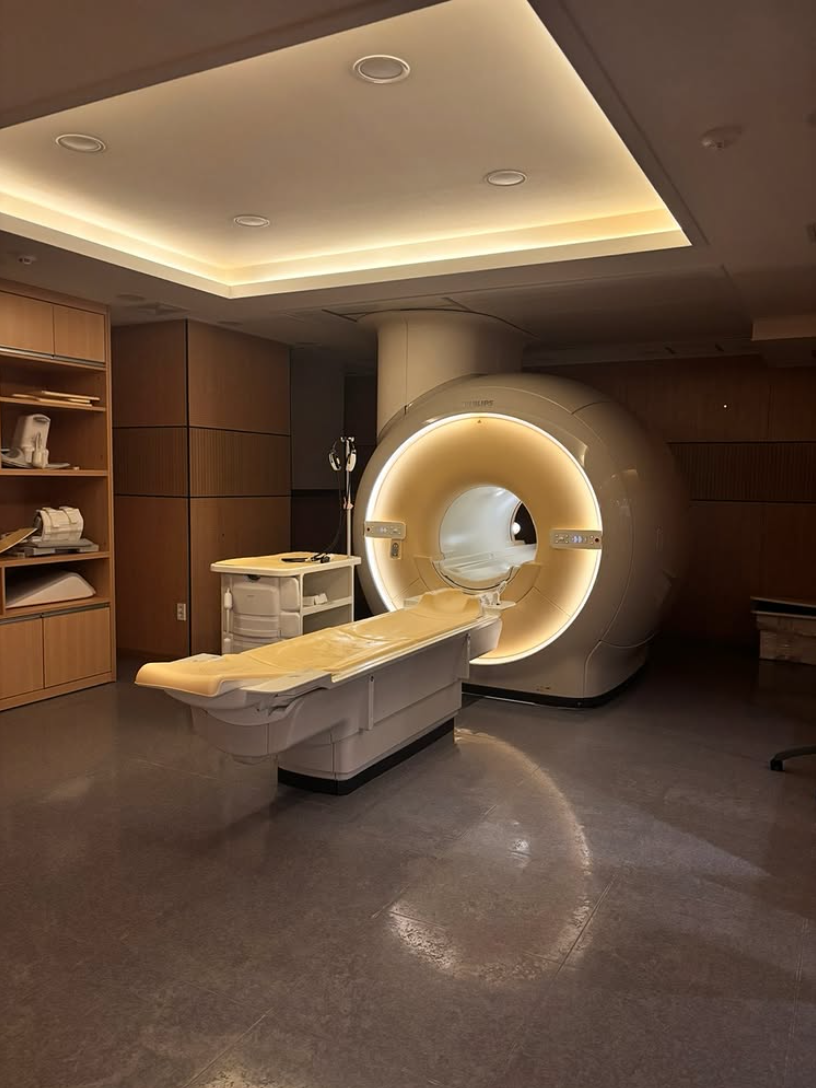
What they find in Korea is simple: comprehensive checkups in Seoul with English coordination, full-day panels, and options like whole-body MRI. Most clients fit the checkup into a morning and keep the rest of the trip free.
What's been telling is who's already showing up early. The most engaged adopters of our checkup packages today aren't the 50-year-olds we'd expect — they're U.S. physicians and Americans in their 30s. To me, that's the clearest signal that using Korea's infrastructure for preventive care is on its way to becoming mainstream.
Not Just a Longer Life, But Healthier Years
U.S. life expectancy has recovered to 79.0 years post-pandemic — a real improvement. But the healthy-life-expectancy gap with countries like Korea has only widened. Living longer isn't the same as living well, and the data is starting to make that distinction visible in ways Americans can't ignore.
That's why a growing share of them are looking abroad for preventive care — and finding it here. Plan your trip with Himedi.com
About the Author
Donkyo Seo — Co-founder & CEO, Himedi
For the past 9 years, Donkyo has helped international patients navigate Korean healthcare. Himedi is licensed by Korea's Ministry of Health & Welfare (License #A-2016-01-01-2345).
Sources
- World Health Organization — Global Health Estimates, healthy life expectancy (Korea, United States)
- OECD Health at a Glance 2025 — life expectancy, healthy years at older ages, per capita health spending
- Statistics Korea (KOSTAT) — 2023 life expectancy
- U.S. Centers for Disease Control and Prevention — Mortality in the United States, 2024
- Korea Ministry of Health & Welfare — 2025 International Patient Statistics (released April 2026)
- Korea Health Industry Development Institute — 2025 medical tourism survey
- Seoul Metropolitan Government — 2024 medical tourism summary

Written by Himedi Inc.
,%20healthy%20l...)